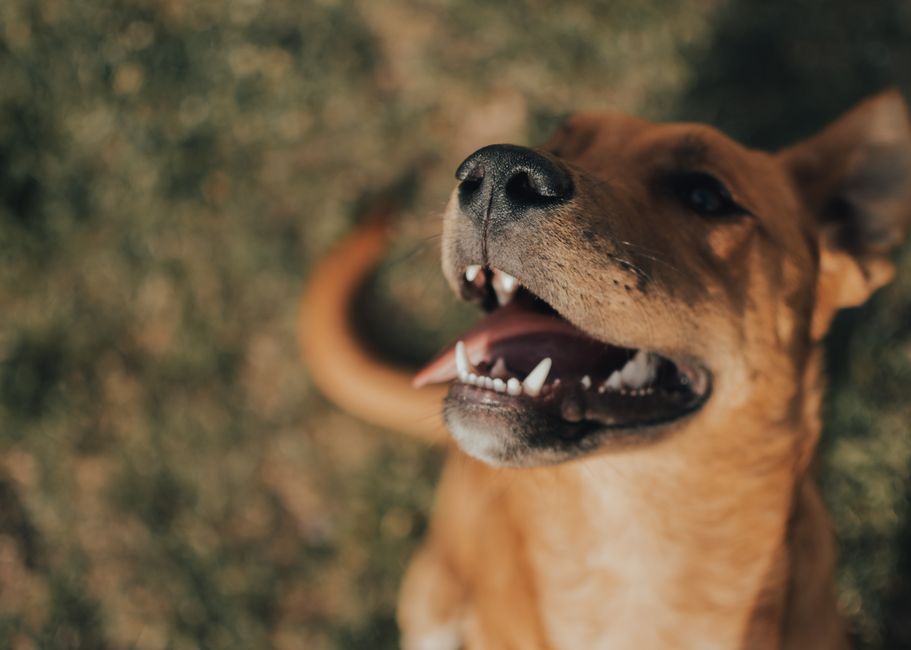
Dog Tail Language Chart
Photo by Gaspar Zaldo on Pexels
This content was created with AI assistance and is not a substitute for professional veterinary advice.
Tail height tells you one thing, and wag speed tells you another – they aren’t the same signal. According to the AKC, “the faster the wag, the more aroused the dog,” while separately, “the higher the tail, the more assertive the dog.” Reading a tail accurately means tracking both at once, not just whether it’s moving.
Tail Height Chart
| Tail Height | What It Signals |
|---|---|
| High, flag-like | Confidence, alertness, possibly assertiveness or aggression |
| Straight out, relaxed | Neutral, comfortable, curious, friendly mood |
| Slightly lowered | Uncertainty or mild submission |
| Low or tucked | Fear, anxiety, or appeasement – Hepper notes “the lower the tail, the stronger the emotional response” |
| Stiff, at any height | Heightened alertness – stiff and elevated together suggests real tension |
Wag Speed And Motion Chart
| Wag Pattern | What It Signals |
|---|---|
| Slow, sweeping | Relaxed, calm |
| Steady, full-body wag (hips moving too) | Genuinely positive mood – the most desirable pattern to see |
| Rapid, twitchy | High arousal – not automatically friendly, needs other signals to interpret |
| Slight, small wag | Relaxed movement, or a nervous, tentative approach |
| Low wag, tail down | Passive submission, not friendliness |
| Helicopter-style full spin | Clear, strong happiness |
The Left-Right Asymmetry Most Owners Have Never Heard Of
This is a genuinely surprising finding worth knowing, not a minor detail. Research cited by both AKC and Hepper found that tail-wagging direction carries real meaning, tied to which brain hemisphere is more active: “dogs tend to wag their tails more to the right when they’re feeling positive about something, such as interacting with their owner. Tails wagged more to the left when dogs faced something negative.” Hepper explains the mechanism – “the brain’s hemispheres trigger responses in the tail on the opposite side,” so right-side-biased wagging reflects left-brain activation (associated with confidence and approach), while left-biased wagging reflects right-brain activation (associated with withdrawal and avoidance). This isn’t something most owners consciously watch for, but it’s a real, research-backed signal alongside height and speed.
Why Neutral Position Varies By Breed
A tail chart only works if you know your own dog’s baseline, since “neutral” looks different across breeds. Hepper notes that Beagles and Huskies naturally carry their tails more vertically even at rest, while Pugs, Shiba Inus, and Pomeranians have naturally curved or curled tails that rarely show the same dramatic wagging range as a straighter-tailed breed. A Pug’s resting curl isn’t a confidence signal the way a high, flag-like tail would be on a Labrador – it’s just that breed’s normal shape. AKC makes the same point: familiarity with your specific dog’s baseline tail position is what actually lets you notice a meaningful shift.
Why Height And Speed Need To Be Read Together
A high, stiff, rapidly wagging tail and a high, loose, slowly swaying tail are not the same dog in the same mood, even though both are “tail up.” The AKC is specific that a high tail can mean confidence or, just as easily, aggression – speed and stiffness are what actually separate the two. Similarly, a low tail with a tight, fast wag reads as anxious submission, while a low, loose, gentle wag can simply be a calm, relaxed dog. Height sets the emotional intensity; speed and looseness describe what kind of emotion it actually is.
Key Takeaways
- Tail height and wag speed are two separate signals – height reflects confidence/arousal level, speed reflects how aroused the dog currently is, and both need to be read together.
- A high tail isn’t automatically a good sign – it can mean confidence or aggression, and stiffness is often what tells the two apart.
- Research shows dogs wag more to the right when feeling positive and more to the left when feeling negative, tied to which brain hemisphere is more active.
- Neutral tail position varies significantly by breed – naturally curled-tail breeds like Pugs and Shiba Inus won’t show the same range as straighter-tailed breeds, so knowing your own dog’s baseline matters more than a universal chart.
FAQ
Can I actually tell which direction my dog’s tail is wagging in real time?
It takes deliberate attention – the asymmetry is often subtle and easy to miss during a normal wag, especially with a fast-moving tail. It’s more useful as a concept to be aware of during a close, calm interaction than something to try to judge from across a room or during rapid movement.
My dog’s breed has a naturally curled tail – can I still use a tail chart at all?
Yes, but the baseline shifts – focus on changes from that breed’s normal resting curl rather than expecting the same dramatic high/low range a straighter-tailed dog would show. A slight uncurling or tightening from your dog’s own normal resting position is more informative than comparing it to a chart built around a different tail shape.
Is a slowly wagging tail always a sign of a relaxed, happy dog?
Not necessarily – a slow wag can mean relaxed, but it can also indicate a cautious, uncertain dog that’s approaching tentatively rather than confidently. Checking the tail’s height and the rest of the dog’s posture (ears, body tension, whether it’s approaching or holding back) gives a much more reliable read than wag speed alone.