Why Does My Dog Sniff Everything?
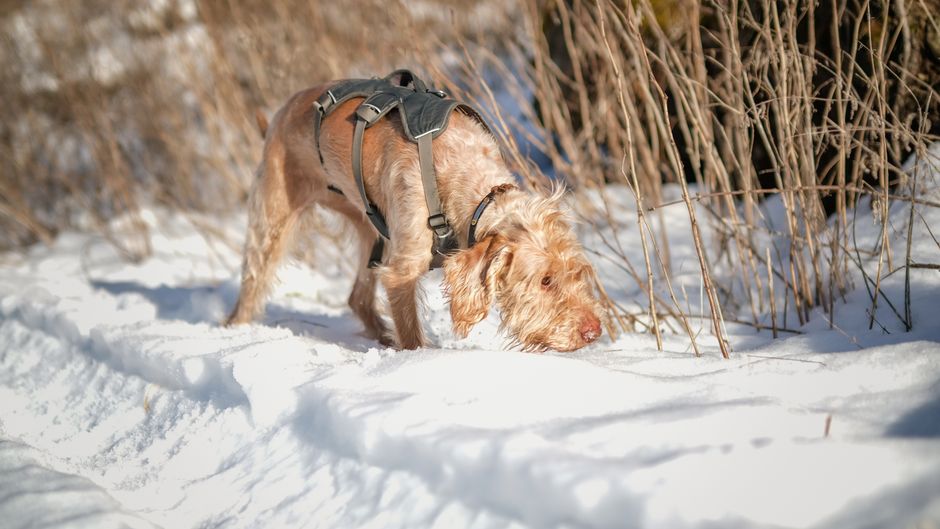
Photo by Andreas Schnabl on Pexels
This content was created with AI assistance and is not a substitute for professional veterinary advice.
Dogs sniff everything because scent is their primary way of understanding the world – not a secondary sense the way it is for people. According to the AKC, dogs have up to 100 million scent receptors compared to a human’s 5-6 million, and sniffing itself has genuine calming benefits, not just informational ones.
The Anatomy Behind It
The numbers here are dramatic. Most dogs have up to 100 million scent receptors, and Bloodhounds specifically carry as many as 300 million – both far beyond a human’s 5-6 million. Dogs can detect some smells in parts per trillion. They also have a specialized structure called the vomeronasal (Jacobson’s) organ, located between the roof of the mouth and the nasal passage, which detects pheromones separately from general scent. AKC notes that roughly one-eighth of a dog’s brain is dedicated to interpreting odor, and a dog’s olfactory cortex is about 40 times larger than a human’s relative to brain size.
What Dogs Actually Learn From A Sniff
Where a person smells a chocolate chip cookie as one unified scent, AKC explains a dog can pick apart “the chocolate chips, flour, eggs, and other ingredients” as distinct components. That same layered detail applies to sniffing other dogs’ scent marks – a dog can pick up real information about another animal’s gender, age, and health status through smell alone. What looks like idle curiosity on a walk is closer to reading a detailed report.
Sniffing Is Genuinely Calming, Not Just Curious
This is easy to underestimate. Scenthound cites the Animal Humane Society noting that “sniffing activates many parts of a dog’s brain, releases the pleasure hormone dopamine, and promotes rest.” Scenthound also references a 2024 study published in the journal Animals showing dogs engaged in regular scent work showed improved impulse control and emotional regulation. Sniffing isn’t just data collection – it’s an activity with a real physiological calming effect.
Why A Short “Sniffari” Can Tire Out A Dog More Than A Run
Scenthound’s practical framing is worth remembering: dedicating just 15-20 minutes to intentional, unhurried sniffing can mentally exhaust a dog roughly as much as an hour-long run. For dogs that seem restless even after physical exercise, this points to a real enrichment gap – physical tiredness and mental tiredness aren’t the same thing, and sniffing specifically addresses the mental side.
How To Let Your Dog Sniff More (The Right Way)
AKC’s suggestion is to build sniffing into structured walks rather than treating it as something to rush through: reward loose-leash walking or heeling with frequent, deliberate sniff breaks, and consider teaching a “go sniff” cue that signals it’s specifically time to explore a spot at their own pace. This turns sniffing into a built-in part of the walk rather than a constant tug-of-war against the leash.
Normal Sniffing vs Worth Watching
| Pattern | Normal | Worth Watching |
|---|---|---|
| Context | Walks, new environments, other animals’ scent marks | Indoors, no obvious scent source |
| Redirectability | Responds to a cue or distraction | Compulsive, can’t be redirected |
| Change | Consistent with the individual dog’s baseline | Sudden increase or decrease |
| Other signs | None | Behavior changes, reduced interest in a senior dog |
When Sniffing Changes Are Worth Watching
Scenthound flags this in both directions, which is worth knowing since most advice only covers one side. A sudden increase in compulsive ground sniffing – especially indoors, in spots with no obvious scent interest, or sniffing a dog can’t be redirected from – can point to anxiety or, less commonly, a neurological issue. Just as notably, reduced interest in sniffing, particularly in a senior dog, can signal cognitive or sensory decline. Either a marked increase or a marked decrease from a dog’s normal baseline is the actual signal worth a vet visit – not sniffing itself, which is completely normal in the vast majority of cases.
Key Takeaways
- Dogs experience the world primarily through smell – with up to 100 million scent receptors (300 million in Bloodhounds) versus a human’s 5-6 million.
- A single sniff carries layered, detailed information most people underestimate, from environmental scent trails to details about other animals.
- Sniffing has a real calming effect, tied to dopamine release and measurable improvements in impulse control from regular scent work.
- A sudden increase in compulsive sniffing, or a notable decrease in interest (especially in a senior dog), are the patterns worth a vet visit – not sniffing in general.
FAQ
Does letting my dog sniff as long as it wants on walks undermine training or leash manners?
Not if it’s built in deliberately – AKC specifically recommends rewarding good loose-leash walking with sniff breaks, which reinforces the training rather than working against it. Treating sniff time as an earned reward rather than a constant negotiation tends to improve leash behavior overall, not weaken it.
Do all dog breeds have the same sense of smell?
No – scent receptor counts vary meaningfully by breed, with scent hounds like Bloodhounds at the very top of the range (up to 300 million) compared to the roughly 100 million typical of dogs generally. Breeds developed for scent work tend to have both more receptors and more brain area dedicated to processing smell.
Can sniffing be used as real mental exercise at home, not just outdoors?
Yes – scattering treats or kibble in grass or a snuffle mat, or hiding treats around a room for a dog to find by scent, both tap into the same mentally tiring effect as outdoor sniffing. It’s a genuinely useful option for enrichment on days when a full walk isn’t possible.