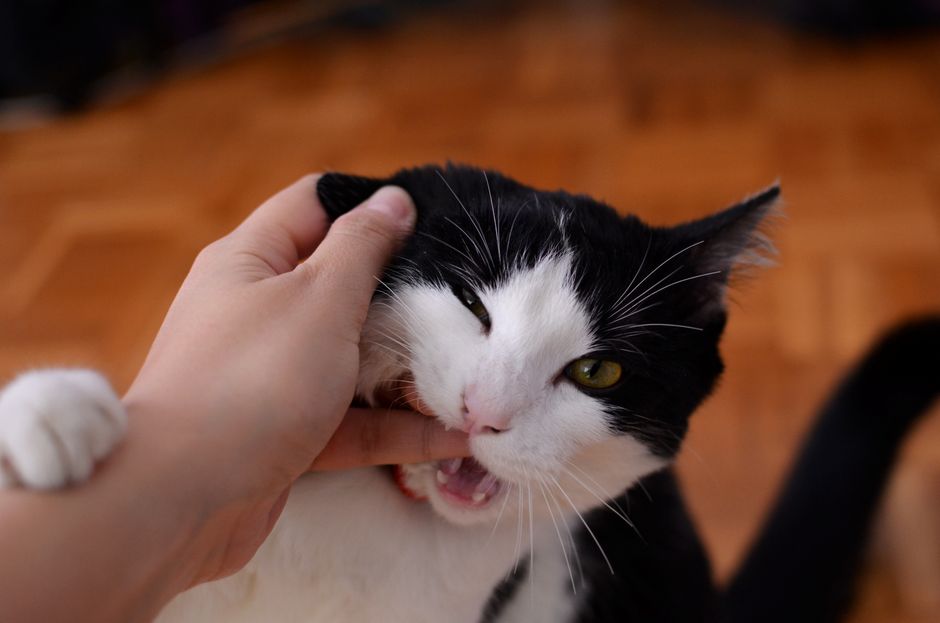
Why Does My Cat Bite Me? The Real Reasons Behind It
Photo by Crina Doltu on Pexels
This content was created with AI assistance and is not a substitute for professional veterinary advice.
Cat biting almost always falls into one of five categories – play, overstimulation, fear, redirected aggression, or an underlying medical problem – and figuring out which one you’re dealing with is the first step to stopping it.
The Real Reasons Cats Bite People
Most biting isn’t random, even when it feels sudden. It usually traces back to one of a handful of well-documented causes:
- Play or predatory aggression – the most common type directed at owners, especially in cats under two years old. It shows up as stalking, pouncing, and ambushing hands or feet, according to the ASPCA – it’s hunting behavior aimed at whatever moves, not a sign of a “mean” cat.
- Overstimulation, or petting-induced aggression – a cat that seems to enjoy being petted suddenly nips and walks off. VCA Animal Hospitals describes this as sensory overload: the same touch that felt good a minute ago stops feeling good, and the bite is the cat’s way of saying so.
- Fear or defensive aggression – a cat that feels threatened and can’t get away may combine flattened ears with hissing, spitting, or a quick bite, per both the ASPCA and VCA.
- Redirected aggression – the cat gets worked up by something it can’t reach, like another animal outside a window, then bites whoever happens to be nearby – sometimes hours after the original trigger. The ASPCA calls this the most dangerous form of feline aggression, because it looks completely unprovoked to the person on the receiving end.
- Pain-induced aggression – a cat that’s normally gentle may bite when touched near an injury or a condition like arthritis or dental disease. Both VCA and the ASPCA list pain as a cause that’s easy to miss, especially in cats who hide discomfort well.
Why Cat Bites Shouldn’t Be Ignored
A cat bite isn’t just a behavior problem – it’s also a real medical one. According to the Cleveland Clinic, the CDC reports that 20% to 80% of reported cat bites become infected, largely because cat mouths carry the bacterium Pasteurella, present in an estimated 70% to 90% of cats. A Mayo Clinic study on hand bites specifically found that around 30% of people treated for a cat bite to the hand required hospitalization. Cat teeth are thin and sharp enough to leave a deep puncture wound that closes over quickly, sealing bacteria in rather than letting the wound drain – which is part of why infection risk is higher than with many other animal bites.
The Warning Signs Before A Cat Bites
Most cats give some warning before they bite, even if it’s brief. Learning to read it is more useful than reacting after the fact:
| Sign | Playful / Affectionate | Heading Toward A Bite |
|---|---|---|
| Ears | Forward or neutral | Flattened back or sideways |
| Tail | Relaxed, slow movement | Rapid flicking or thrashing |
| Body | Loose, relaxed posture | Tense, crouched, or suddenly frozen |
| Sound | Silent, or purring | Hissing, growling, or spitting |
If you notice the right-hand column starting during petting or handling, that’s the moment to stop, not push through to “finish” the interaction.
How To Stop The Biting
- Learn your cat’s threshold. Keep petting sessions shorter than the point where your cat usually turns to bite, and stop before you get there.
- Use a consistent cue to end contact, like standing up or saying “all done,” so your cat learns a predictable signal instead of having to escalate to a bite to get you to stop.
- Reward calm behavior rather than punishing bites after they happen – punishment doesn’t address the underlying trigger, and for fear- or pain-based biting it can make a cat more defensive next time, not less.
- Identify which areas your cat actually tolerates. Many cats are fine with chin or cheek scratches but bite when touched on the belly or lower back.
- Redirect play biting onto a wand toy, never your hands or fingers – if hands are an acceptable play target sometimes, a cat can’t reliably tell when they aren’t.
- For redirected aggression, give your cat space and time to settle rather than approaching or picking them up right after you notice they’re worked up about something else.
When To See A Vet Immediately
- A previously gentle cat suddenly starts biting. Rule out pain first – the ASPCA notes that all cats showing new aggression should get a veterinary exam before you assume it’s purely behavioral.
- Biting is frequent, escalating, or not improving despite shorter petting sessions and avoiding known triggers – this is when a referral to a veterinary behaviorist is worth asking for.
- A bite breaks your skin, especially on the hand or near a joint. The Cleveland Clinic recommends seeing a doctor within about eight hours to cut your own infection risk, given how often cat bites become infected.
Toys And Tools That Help
- Wand or fishing-pole toys let a cat direct predatory play at an object at a distance, instead of at hands.
- Pheromone diffusers are sometimes used to help reduce general stress that can contribute to fear- or overstimulation-related biting.
- Nail caps can reduce injury during play or overstimulation bites while you’re still working on the underlying behavior.
- A cat tree or perch near a window gives an outlet for watching outdoor animals, which can reduce the buildup behind redirected aggression.
Key Takeaways
- Cat biting falls into a handful of distinct categories – play, overstimulation, fear, redirected aggression, or pain – and the right fix depends on which one it is.
- Ears back, tail flicking, and a suddenly tense body are the most common warning signs before a bite.
- Cat bites carry a real infection risk (the CDC puts it at 20-80%), so a bite that breaks skin is worth medical attention, not just a bandage.
- A sudden change in a previously gentle cat’s biting behavior is a reason to see a vet first, before assuming it’s just a training problem.
FAQ
Is it true that kittens grow out of biting?
Play-biting often decreases as cats mature past about two years old and get more outlets for predatory behavior, but it doesn’t disappear on its own if hands and fingers are still used as toys during play – the habit has to be redirected onto toys, not just waited out.
Should I ever hold my cat’s mouth shut or tap its nose when it bites?
No – physical correction doesn’t address why the cat bit in the first place, and for fear- or pain-based biting it can make a cat more defensive the next time. Redirecting to a toy and giving space works better than any physical response.
Does redirected aggression mean my cat is holding a grudge?
No – it’s not delayed retaliation, it’s residual arousal. The cat is still physiologically keyed up from whatever it originally saw or heard, sometimes for hours, and the next living thing that walks by becomes the outlet – which is why it can look like it came out of nowhere.